In today's fast-paced, highly competitive textile market, customers are demanding ever-shorter delivery cycles. Backlogs of orders not only impact factory scheduling efficiency but can also lead to customer churn, damage reputation, and even direct order cancellations and breach of contract compensation.
"Production is flawless, but shipments are hindered"—this is a common challenge faced by many dyeing and finishing plants. Before shipment, finished fabrics must undergo multiple processes, including inspection, packaging, labeling, weighing, and warehousing. Any delay in any of these steps can become a bottleneck in delivery.
All of this is being radically changed, starting with the introduction of high-speed, intelligent fabric inspection and packaging lines.
The Biggest Obstacle to Delivery
Most factories still use a decentralized, manual fabric inspection, packaging, and stacking system. Each roll of fabric undergoes multiple manual handling and repetitive operations, leading to numerous problems:
Inspection is slow, quality control relies on manual experience, and efficiency and accuracy are inconsistent.
Packing processes overlap, making it difficult for multiple personnel to synchronize and align, making errors more likely.
Data recording lags, preventing real-time sharing of production, quality, and inventory information.
The labor intensity is high, and night shifts and rush orders are more prone to errors and accidents.
Space utilization is low, requiring a large amount of space for the stacking and circulation of semi-finished products.
This model not only lengthens the fabric delivery cycle but also easily leads to delivery delays and production congestion during peak order periods.
One-Stop Solution
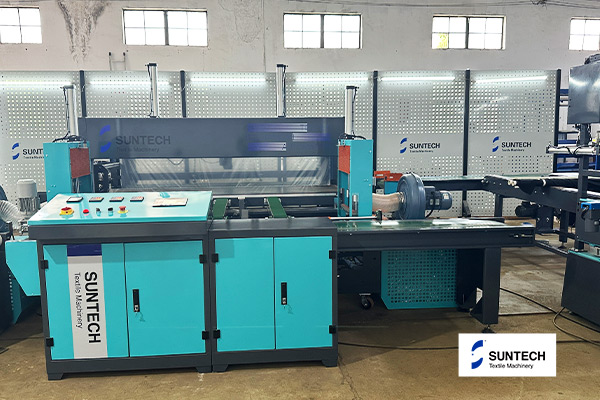
To address various inefficiencies in the shipping process, SUNTECH has launched a high-speed, intelligent solutions of AI fabric inspection and automated packing line that automates the entire process from fabric inspection, labeling, counting, weighing, packaging, to stacking and warehousing. This truly achieves:
✅ One-Stop Integration
This streamlines the entire process from fabric inspection to packaging to shipping, eliminating manual handling and saving 80% of labor.
✅ High-Speed Operation
The entire line can reach speeds of up to 60 meters per minute, far exceeding manual inspection and stand-alone operation, making it suitable for fast turnaround of medium and large-volume orders.
✅ Automatic Labeling
AI cameras accurately identify defects and automatically label them, reducing subjective judgment errors and ensuring traceable quality records.
✅ Automatic Packaging & Stacking
Intelligent robotic arms automatically package, seal, and stack according to specifications, ensuring standardized packaging and improving warehouse efficiency.
✅ Real-Time Data Integration
Interconnecting with MES/WMS systems, it automatically generates labels and records information such as weight, fabric length, and defective rate, enabling visual management.
Customer Case Studies
Factories using SUNTECH's high-speed fabric inspection and packaging lines in projects in Vietnam, Turkey, and Pakistan have reported the following:
Daily shipment capacity has increased, supporting tighter delivery schedules.
Labor employment has been reduced by over 60%, with significant reductions in night shift costs.
Defective product outflow has been reduced, significantly reducing customer complaints.
Improved order acceptance capacity has enabled factories to more confidently accept large orders with short lead times.
Conclusion
With the trend toward flexible production and quick-response supply chains, those who can shorten the order-to-shipment cycle will seize market leadership. High-speed, intelligent fabric inspection and packaging lines are crucial for factories to achieve a win-win situation of both rapid delivery and quality assurance.
Still worried about delivery delays and backlogs? It's time to let back-end automation help you ship with ease!
Contact us for complete line layout solutions and customer case studies!