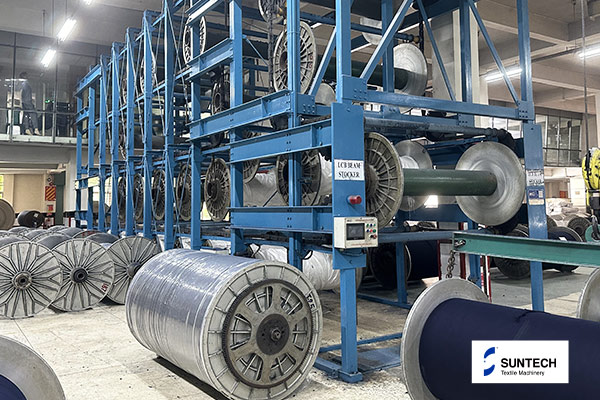
In weaving sheds and raw material warehouses, the storage and management of warp beams have always been critical factors affecting space utilization and production efficiency.
As production capacities expand and fabric varieties increase, traditional floor-stacking or manual retrieval methods are no longer sufficient to meet the safety, efficiency, and space requirements of modern weaving mills. Consequently, the Automated Storage and Retrieval System (ASRS) for Beam Stackers—commonly known as a smart beam warehouse—is becoming the go-to solution for optimizing storage space in the textile industry.
Why Warp Beam Storage Becomes a Space Bottleneck
In practice, many weaving mills encounter the following challenges:
Increasing Beam Inventory: A growing number of beams consumes massive amounts of floor space.
Underutilized Vertical Space: Warehouse height is often left wasted.
Low Manual Efficiency: Manual retrieval is slow and prone to errors.
Management Chaos: Tracking and scheduling beams becomes time-consuming.
These issues do more than just waste space; they directly hinder the efficiency of the weaving preparation process.
In the context of warp beams, ASRS is typically integrated with a Beam Stacker to enable:
Vertical Multi-Layer Storage: Maximizing the use of height.
Automated Inbound/Outbound Logistics: Precise positioning and retrieval.
Digital Tracking: Real-time monitoring of beam status and location.
This upgrades warp beam storage from simple "stacking" to a "systematic management" model.
How Smart Beam Stackers Maximize Storage Space
1. Full Utilization of Vertical Space
Compared to traditional horizontal storage, a Beam Stacker ASRS utilizes the full height of the warehouse. On the same footprint, the storage capacity for warp beams can be significantly increased.
2. High-Density and Safe Design
Through standardized rack positions and automated stacking structures, the safety distance between beams is precisely controlled. This eliminates the risk of collisions and damage often associated with manual handling.
3. Reduced Aisles and Redundant Space
Automated systems do not require the wide aisles needed for manual forklifts or trolleys, allowing for a more compact warehouse layout and freeing up valuable floor area for production.
Efficiency Gains Beyond Space Optimization
Beyond space savings, an intelligent beam warehouse brings significant operational improvements:
Rapid Retrieval: The system automatically locates the target beam, slashing search time.
Lower Labor Dependency: Reduces the intensity of manual handling and transport.
Enhanced Safety: Minimizes risks associated with moving heavy loads manually.
Minimized Loom Downtime: Ensures beams are delivered to the weaving machines on time.
Digital Management: Making Beams "Visible and Controllable"
Modern ASRS for Beam Stackers are equipped with smart management software that provides:
Real-time visibility of beam positions and status.
Automatic logging of all inbound and outbound movements.
Seamless integration with production planning and scheduling.
This transforms warp beams from "static inventory" into "dynamic, controllable resources."
SUNTECH’s Intelligent Storage Solutions
SUNTECH offers an automated Beam Stacker system specifically designed for the storage and management needs of weaving mills:
Vertical Space Maximization: Engineered to utilize every inch of height.
High-Density Safety: Secure storage for various beam sizes.
Seamless Integration: Works perfectly with equipment like Electric Warp Beam Trolleys.
To truly maximize warehouse space, expansion is not always the best answer. By introducing an Automated Storage and Retrieval System (ASRS) for Beam Stackers, weaving mills can achieve higher storage density, more efficient scheduling, and safer management within their existing footprint.
The smart beam warehouse is becoming an essential infrastructure for modern weaving plants to enhance both space value and operational efficiency.